Stanford Humanities Center


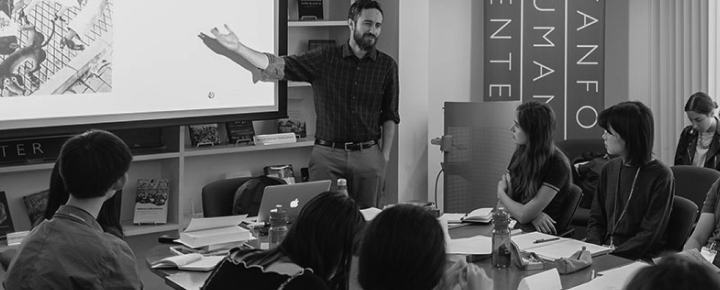
Mapping Absence: Global Explorations of Disappearance in Art, Law, and Social Science was a multidisciplinary symposium that took place May 14–19, 2025, in a hybrid format, at Stanford University. The symposium was sponsored by the Tinker Fund through Stanford’s Center for Latin American Studies, with cosponsorship from the Stanford Global Studies’ workshop “Law and Literature in the Global South,” the Division of Literatures, Cultures, and Languages, the Stanford Humanities Center, as well as the Departments of Anthropology and Art & Art History.
More than eight hours of conference recordings can be found below.
Opening Panel: Legal Framings of Disappearance
The opening panel of Mapping Absence: Global Explorations of Disappearance in Art, Law, and Social Science featured insights from legal experts, practitioners, and scholars. Moderated by Guilherme Vasconcelos Vilaça, this panel explored the legal and social complexities of enforced disappearances—such as missing migrants and violence by non-State actors—while emphasizing the need for transdisciplinary approaches that combine law, social sciences, and the arts to support victims and address systemic impunity. Speakers: Grazyna Baranowska, Bernard Duhaime, Anna Rahel Fischer, and Pietro Sferrazza Taibi.
Panel 2: Art-ivism and Migration in Latin America
The second panel of the symposium featured artist Derli Romero and Associate Professor Kimberle López. They explored art-ivism through Romero’s projects Rostros Migrantes and Mujeres en tránsito, which humanize migration by sharing the narratives of Central and South American migrants crossing Mexico. Both works focus on migrants’ personal experiences with violence, kidnapping, family separation, and community-building efforts. Building on the first panel’s analysis of the legal complexities of enforced disappearance, Romero and López’s conversation highlighted experiences of migration and overlapping questions of migration and enforced disappearance. Note that the panel was conducted in both English and Spanish.
Panel 3 (in Spanish): Legal Complementarity and Embodied Knowledges of the Search
In this panel, Matilda González Gil, Lisa Ott, Constanza Ramírez Molano, and Carolina Robledo Silvestre shared examples of community-driven searches for those who have been disappeared, such as identifying missing LGBTI+ individuals through clothing and historical cultural trends, using public musical performances as social pedagogy, and tracing the evolution of family-led buscadora (searcher) movements in Mexico. This discussion illustrated the importance of combining legal investigations with community-driven epistemic practices and artistic expressions to effectively search for the missing and support their families. Note that this panel was conducted in Spanish.
Panel 4: Phenomenological Accounts of Displacement and Disappearance
“Phenomenological Accounts of Displacement and Disappearance” featured Promise Ejiofor, Ayten Gündoğdu, Juliana Martínez, and Julia Neusner. They discussed enforced disappearances across global contexts—from Nigeria, the Euro-Mediterranean, the US-Mexico border, and Colombian cultural production. Together, they examined the phenomenological, ethnographic, and aesthetic dimensions of how marginalized populations are vanished by structural violence, restrictive border policies, and climate change, while highlighting the tension between statistics and individual stories.
Panel 5 (in Spanish): Social Narratives in the Aftermath of Disappearance
Building on the previous panel’s focus on the “visibility” of disappearance, this discussion examined how those complex human experiences are translated into concrete social narratives, truth-seeking efforts, and artistic media to foster collective memory and healing. In this panel, Jennifer Alpert, Cath Collins, Luis Gómez Romero, and Luz Marina Monzón discussed how societies process the trauma of disappearances through transitional-justice mechanisms, literature, and film. The panelists emphasized that the search for the missing must go beyond strictly legal or forensic narratives to address the right to truth at the level of individuals, families, and societies in order to combat pedagogies of cruelty and rebuild severed community bonds. Note that this panel was conducted primarily in Spanish.
Panel 6: Disappearance on Screen
Martha González, a searching mother from the Colectivo Solecito de Veracruz, joined filmmaker Rodrigo Reyes in a conversation moderated by Ximena Briceño. The conversation centered on Reyes’ documentary 499, which blends fact and fiction by following a Spanish conquistador who returns to modern Mexico to examine the ongoing legacy of colonial violence and enforced disappearances. Martha shared her experiences of discovering the massive Colinas de Santa Fe mass grave, the psychological toll of her search for her disappeared son, and how participating in the film provided a platform to share her story and combat the normalization of violence. Note that the panel was conducted in Spanish and utilized live human interpretation via Zoom.
Final Panel: Book Talk: Nightmare Remains: The Politics of Mourning and Epistemologies of Disappearance (2024)
The closing panel for the symposium centered on a book talk with philosopher Ege Selin Islekel in conversation with anthropologist Kabir Tambar. Islekel presented on Nightmare Remains, her study of how State powers manage the “right to death” by erasing archives and making bodies absent across contexts including Argentina, Colombia, and Turkey. The conversation highlighted how movements such as the Saturday Mothers produced “nightmare knowledge” that served as vital epistemic resistance against State-sponsored erasure.
Other Conference Events
The symposium’s other events included poets and writers such as Adedayo Agarau, Chantal Flores, Aracelis Girmay, and Priscilla Wathington read and discussed their poetic reflections on the worlds created by and in disappearance.
Human-rights advocates such as Delia Caicedo, of Fundación Guagua in Cali, Colombia, led a workshop on documenting cases of enforced disappearance and human-rights abuses in southwestern Colombia and curated a pop-up exhibit at the Center for Latin American Studies with art-ivist work by searching mothers who work with the Fundación Guagua.
Sociologist Gabriel Gatti led two workshops on writing and disappearance, including an event on a new collective project, Vidas descontadas, that expands the notion of social disappearance.
A pop-up exhibit at Stanford’s Green Library showcased materials ranging from Ester Hernández’s Libertad, Tejido de desaparecidos, and Sun Mad Raisin to Derli Romero’s Rostros Migrantes and Mujeres en tránsito.
As a space to reflect on modes of resisting disappearance and chart new paths in this direction, the symposium spurred not only this Colloquy but also the digital platform Mapping Absence (please follow this link).
Join the Colloquy


Join the Colloquy
Global Reckonings with (Enforced) Disappearance in Art, Law, and Social Science
more
Across film discussions, hands-on workshops, panel presentations, poetry readings, and pop-up exhibits, this group sought to appraise the history of enforced disappearance and expand conversations constellating around new iterations of disappearance.
That symposium spurred this Colloquy, whose title captures its aspirations: Global Reckonings with (Enforced) Disappearance in Art, Law, and Social Science. To reckon with disappearance “is, at its core, a challenge of assembling the right knowledge, drawn from the right fields, in service of the right goals,” to channel contributors Bernard Duhaime and Myriam Pigeon.
With that goal in mind, this Colloquy reckons with disparate forms of approaching disappearance. It reckons with the predominant understanding of enforced disappearance, the traditional form associated with State-directed systematic programs of terror, and the incredible activism and labor of those who search for the disappeared. Yet, at a time when the term “disappeared” now refers to a plural category used to map absences of various sorts across Latin America and beyond, it is incumbent “to provoke” (in the sense of provocare, to call forth) reflections on the uncertainty pervading what global reckonings entail.
The very choice of the word reckoning in our title conveys not only a sense of the very doom carried by disappearance, of the horrifying uncertainty regarding a loved one’s fate and whereabouts, but also an accounting in the tripartite meaning of what it means to “contar la desaparición” that sociologist Gabriel Gatti presented in the 2025 symposium: to account for, to keep count of, and to tell stories about. In line with this ethos, this Colloquy seeks to provoke a meta-discussion of how we speak of the creation of absence, of the willful ignorance of absence, of the acceptance of absence, all of which are factors that make the realities of (enforced) disappearance possible.
For that reason, this Colloquy brings together documentaries, essayistic reflections, original argument-driven articles, poems, short stories, symposium recordings, material translated into English for the first time (including a study of documentary film in Mexico, scholarship on non-State actors and enforced disappearance in international law, and campaigns related to the search for LGBTIQ+ persons in Colombia), and more, all with an eye toward contributing a granito de arena (grain of sand) to the urgency of these global contexts.
Thus, in posing whether fiction about a video game or the vanishing of a suitcase might offer insight into how societies grapple with enforced disappearance, our aim is less a prescriptive question of endorsing or critiquing the concept of disappearance beyond traditional frameworks than a call to recognize the historical necessity of the original paradigm—which was forged to differentiate (enforced) disappearance from other crimes within the context of Southern Cone dictatorships—alongside the contemporary modes of resistance that turn to the language of disappearance. It is a call to reckon with the question of how these new forms shape our understanding of the “traditional form,” and, conversely, of what the “traditional form” tells us about climate change, human mobility, and border regimes. Taken holistically, this Colloquy interrogates the emergence of unexpected forms of understanding disappearance while acknowledging the risk of conceptual dispersion and addressing the concerns of those who fear that broadening the definition of disappearance might dilute the term’s legal and historical weight.