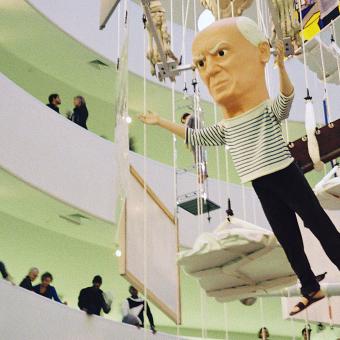
Winn considers the commentaries that the artwork in Zabala's exhibition make on urgent global emergencies, including addiction, climate change, and violence.
In June 2003, the Andy Warhol Museum in Pittsburgh mounted an exhibition of Warhol's iconic Electric Chair print series—ten large-scale prints along with several smaller prints and paintings—as a catalyst to generate discourse on the issue of capital punishment. The project, Andy Warhol's Electric Chairs: Reflecting on Capital Punishment in America, which came two years after the execution of Timothy McVeigh and shortly after the decision by Illinois Governor George Ryan to commute all death sentences in that state, raised significant questions about the social utility and morality of the death penalty.
I want to focus on three diverse examples of trickle-up innovation—Theatre of the Oppressed, ACT UP, and the Pro-Test Lab—with mentions of others to encourage more cultural-agent spotting. Artists are never simply victims of circumstance. Their agency sets off creative responses. To follow through from the call of social challenges to the responses of aesthetic innovation is to stimulate collective change.
This book-length manifesto offers itself as both love song and lament. I interrogate research-creation as a genre full of exciting pedagogical and institutional possibility. I also lament the hopeless exhaustion I see in colleagues all around me. As a strategy of resistance to the resignation that surrounds me daily in the arts and humanities wings of the university, I look to research-creation, even as it is being commodified right under our feet, as a site of generative recrafting: a touchstone and orienting point that might help render daily life in the academy more pedagogically, politically, and affectively sustainable.
Artists in this exhibition responded to challenges of, and consolations of, sanctuary. Sanctuary, we learned, is not an abstraction; it is a relative term that we negotiate.
Literature creates what virtual reality tries to erase: the frame or boundary we fashion around the fabricated image that helps to better appreciate the real one.
On the vital role of the arts and hermeneutics in the current political climate.